
Bhai Phonta 2026 | ভাইফোঁটা ২০২৬
Looking for calendar views and tithis?
Read more about the exact tithi timings and planetary alignments in our comprehensive November 2026 Calendar.
About Bhai Phonta(উৎসব পরিচিতি)
Across India, this day is known as Bhai Dooj. In Maharashtra it is Bhau Beej. In Nepal it is Bhai Tika. In Uttar Pradesh and Bihar it is Yama Dwitiya. The names differ, the regional customs differ in detail, but the emotional core is the same across all of them: a sister prays for her brother's long life and health, marks his forehead with a protective symbol, and feeds him the best meal she can make.
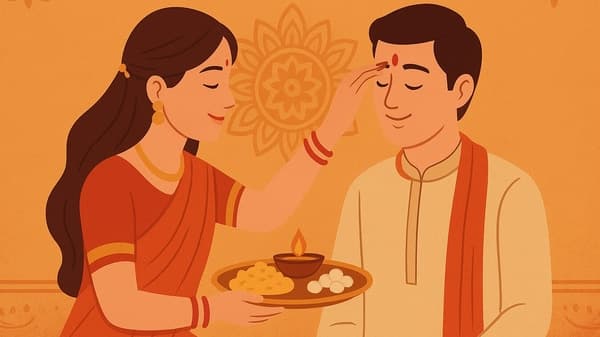
In Bengal, the festival is called Bhai Phonta — from *phonta*, meaning the dot or mark applied on the forehead. The Bengali version is among the most ritually detailed of all the regional forms, with a specific three-ingredient mark, a Sanskrit-Bengali chant, and a full traditional feast that is one of the most anticipated meals in the Bengali household calendar.
The day is also called Yama Dwitiya, which points directly to its mythological origin: the second day (Dwitiya) when Yama, the god of death, visited his sister Yamuna and received a protective mark from her. Every sister who applies the Phonta on Bhai Phonta is doing what Yamuna did — placing a thorn at Yama's door, asking him to stay away from her brother for another year.
Yama and Yamuna (also called Yami) are twins — the children of Surya, the sun god. They are separated by Yama's responsibilities: he rules the realm of the dead, and the distance between life and death is the distance between them. The story goes that Yamuna had been calling Yama to visit her for a long time, and he kept being pulled away by his duties. Finally, on the Dwitiya of Kartik, he arrived.
Yamuna welcomed him with full sisterly honour: she bathed him, fed him the best meal she could prepare, applied a tilak (mark) on his forehead, and prayed for his well-being. In return, Yama was so moved by her love that he declared this day sacred for the bond between siblings everywhere — and announced that any brother who receives his sister's mark and blessing on this day will be protected from untimely death.
In Bengal, this story is encoded in the specific chant recited during the Phonta application:
*"Bhai-er kopale dilam phonta, Jomer duare porlo kanta,*
*Jamuna dey Jomke phonta, Ami di amar bhaike phonta."*
Translation: *I put a mark on my brother's forehead, placing a thorn at Yama's door. Just as Yamuna marked Yama, I mark my brother for long life.*
The chant is in a distinctly Bengali mix of Sanskrit and Bengali, and it has been passed down through generations of Bengali sisters — taught by mothers to daughters, learned by girls before they understood what Yama meant, remembered long after childhood has ended.
There is a parallel story in the Mahabharata tradition: the day Krishna visited his sister Subhadra after the killing of Narakasura (on Naraka Chaturdashi). Subhadra welcomed him with sweets and applied a tilak on his forehead, praying for his well-being. This is why some traditions connect Bhai Dooj specifically to the Narakasura story as well.
Unlike Raksha Bandhan, where the sister ties a thread and the brother gives a gift, Bhai Phonta puts the sister in the active role throughout. She applies the mark. She recites the chant. She prepares or arranges the feast. She prays. The brother is the recipient of all of this — and the gift-giving that follows is his response to what she has given.
For sisters separated from their brothers by distance — which for many Bengali families means a sibling in another city, another country — Bhai Phonta is the day the effort is made regardless. Brothers travel home. Sisters plan the meal weeks in advance. In families where siblings live in different countries, video calls are made, and some families perform a symbolic Phonta via screen — which carries the same emotional weight even when the logistics have changed.
The day is simultaneously a celebration and a petition. The sister is saying: I see you. I want you to live. I am asking the universe to keep you safe. The brother eats the meal she has cooked and gives her something in return. Both of them are, for this one day, children again in the way that only siblings can make each other feel.
Rituals & How to Celebrate
Traditional Foods & Bhog
Festival Calendar
Bhai Phonta
২৫ কার্তিক • ভাইফোঁটা ২০২৬