
Jagaddhatri Puja 2026 | জগদ্ধাত্রী পূজা ২০২৬
Looking for calendar views and tithis?
Read more about the exact tithi timings and planetary alignments in our comprehensive November 2026 Calendar.
About Jagaddhatri Puja(উৎসব পরিচিতি)
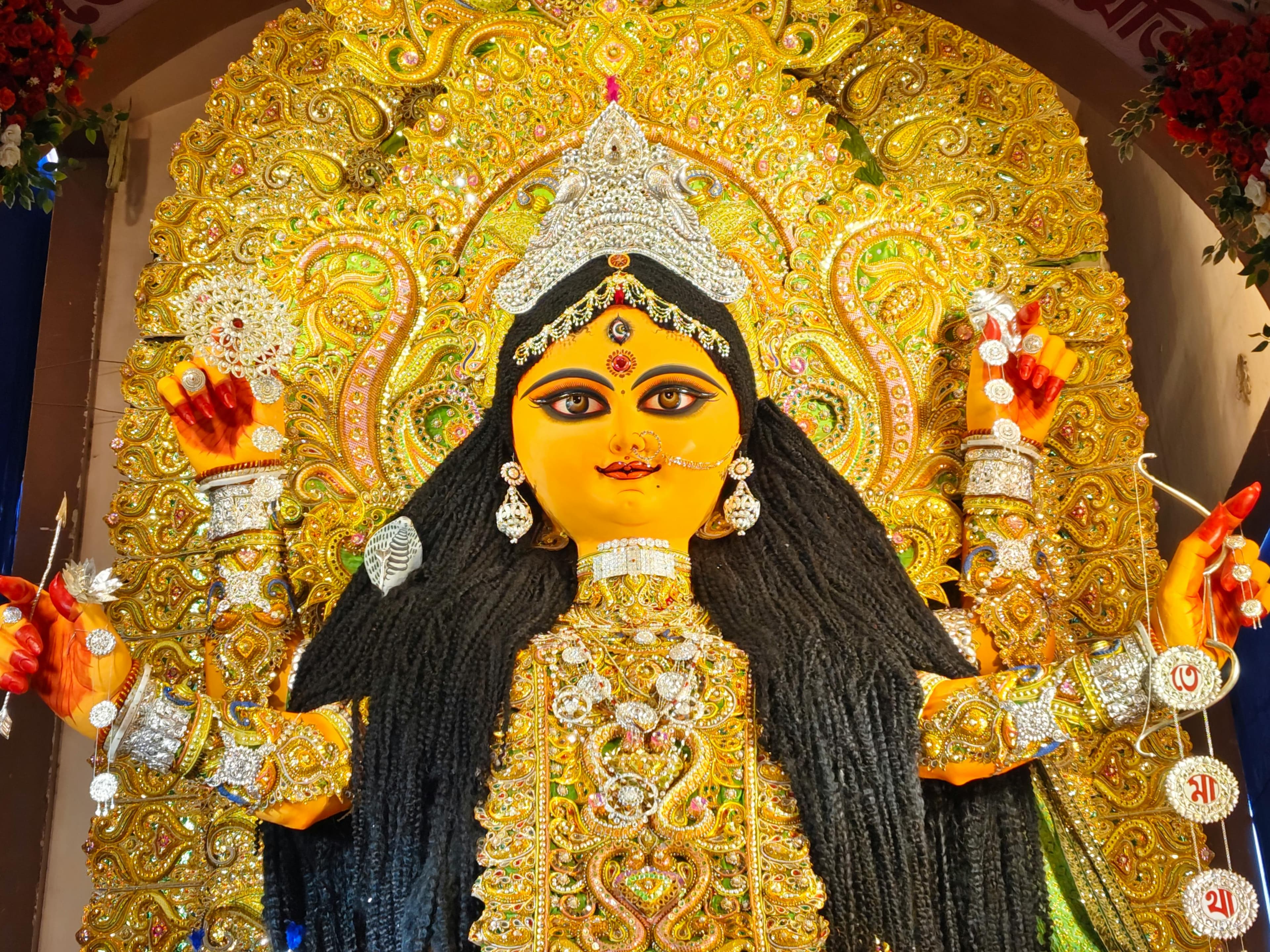
Jagaddhatri means 'the one who holds the world' — Jagat (world) + Dhatri (holder, bearer). She is a form of Durga: golden-complexioned, with four arms, riding a lion, the lion standing on the back of a prostrate elephant. The elephant in Hindu symbolism represents ego — enormous, powerful, and difficult to overcome. The lion represents the Goddess's power. Jagaddhatri is the force that subdues ego and holds the world in balance.
The festival is observed across Bengal, but two cities have made it their own in a way that has no parallel elsewhere: Chandannagar (Chandernagore) in Hooghly district, and Krishnanagar in Nadia district. In these two cities, Jagaddhatri Puja is not smaller than Durga Puja — it is the festival that defines them. The Chandannagar puja in particular is known globally for *Chandannagorer Alo* — an electric lighting tradition that has been developing since the early 20th century and now produces illuminated tableaux of extraordinary complexity, using millions of coloured bulbs to create moving, animated depictions of mythology, nature, and narrative.
Channannagar's relationship with Jagaddhatri Puja has a separate and remarkable history. The city was a French colonial possession from 1673 to 1950 — one of the few French territories on the Indian subcontinent. The French influence brought European decorative traditions to the city: an interest in theatrical lighting, elaborate public display, and the conversion of streets into illuminated spaces. Bengali artisans absorbed these traditions and transformed them. What emerged — Chandannagorer Alo — is entirely Bengali in content and execution but traces its festive public illumination aesthetic to the encounter between French colonial culture and Bengali artistic genius.
By the late 19th century, Chandannagar's Jagaddhatri Puja processions were already famous for their lighting. In the 20th century, as electric lighting became available, the art form escalated dramatically. Today the illuminated panels created in Chandannagar — some of them entire streets transformed into a single unified light installation — are designed by professional artists, require months of preparation, and draw visitors from across India and abroad specifically to see them. The procession on Navami night, when the illuminated idols and panels move through the streets, is one of the great spectacles of the Bengali festival calendar.
The Navami in 2026 — November 18 — is the primary puja day. The Bisarjan (immersion) happens on Dashami, which falls on November 19 in 2026. Chandannagar's immersion procession on Dashami night is among the most photographed in Bengal — the illuminated idols moving through the streets to the Hooghly is something the city choreographs with extraordinary care.
The goddess's iconography is worth understanding distinctly from Durga. Jagaddhatri is always depicted as golden, seated on a lion, with four arms holding a conch shell (shankha), a discus (chakra), a bow, and an arrow. The lion stands on the back of a defeated elephant — the elephant is the demon Karindrasura (representing ego and pride), who was subdued by the goddess. This is different from Durga, who stands on the buffalo-demon Mahishasura. Both are forms of the same divine power, but the enemy is different: Durga defeats brute force and tyranny; Jagaddhatri defeats ego.
Rituals & How to Celebrate
Traditional Foods & Bhog
Festival Calendar
Jagaddhatri Puja
৩ অগ্রহায়ণ • জগদ্ধাত্রী পূজা ২০২৬