
Mahalaya 2026 | মহালয়া ২০২৬
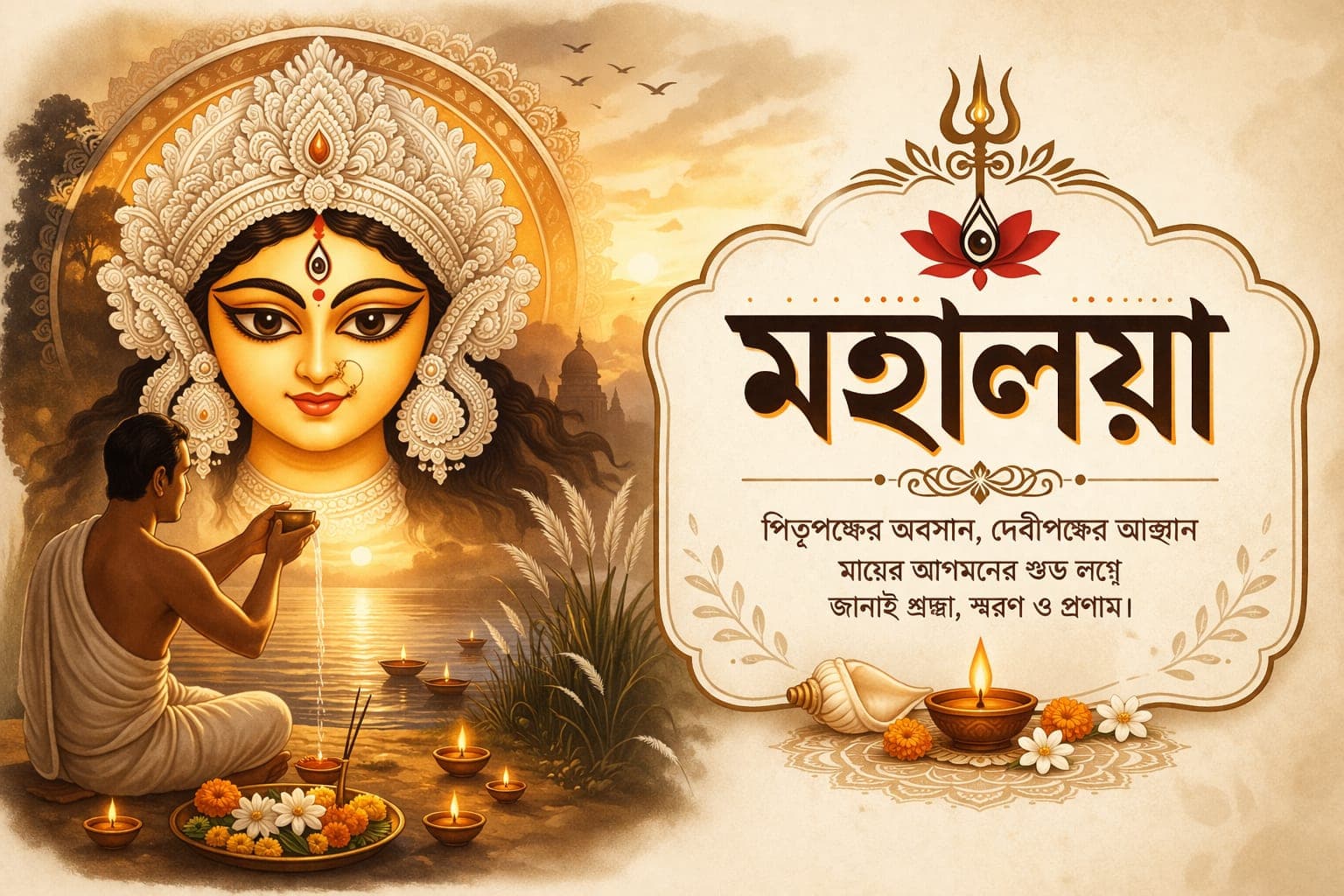
Looking for calendar views and tithis?
Read more about the exact tithi timings and planetary alignments in our comprehensive October 2026 Calendar.
About Mahalaya(উৎসব পরিচিতি)
If you grew up in a Bengali household anywhere in the world, you know exactly what happens on this morning. The alarm is set for 3:45 or so. The house is still dark and completely quiet. Someone puts on the radio or the cassette or — these days — the YouTube stream. And then Birendra Krishna Bhadra's voice comes through, low and resonant, beginning the Chandi Path. "Ya devi sarva bhuteshu..." And something in you that was dormant since last Dashami wakes up.
That is Mahalaya. Not a puja, not a government holiday, not a formal ritual — just a sound, a time of day, and an emotion that four generations of Bengalis have shared across every continent they've scattered to.
The day itself carries two separate meanings that sit side by side. The first is ancestral: Mahalaya marks the last day of Pitru Paksha — the fifteen-day period of honouring and feeding one's departed ancestors. From sunrise, men go to the river for Tarpan, offering water and black sesame to the souls of their fathers and forefathers. The second meaning is the beginning of everything Bengalis love most: Devi Paksha starts today. Maa is coming.
But what transformed Mahalaya from a solemn ancestral observance into the emotional centrepiece of Bengal's festive year was a single radio broadcast.
In 1931, All India Radio commissioned a programme called Mahishasura Mardini — a recitation and musical rendering of the Chandi (Devi Mahatmyam), the Sanskrit text that tells the story of Durga's battle with the buffalo demon Mahishasura. The script was written by Bani Kumar. The music was composed by Pankaj Kumar Mallick. And the voice — the unmistakable, impossible-to-replicate, slightly gravel-and-gold voice — was Birendra Krishna Bhadra's.
The broadcast first aired on Mahalaya morning at 4 AM. People woke up specifically to listen to it. Within a few years, it had become the ritual. By the 1950s and 60s, it was woven into Bengal's collective identity more deeply than almost any other cultural event. Today, the original 1966 recording is what most people listen to — Birendra Krishna Bhadra died in 1991, but his voice on that recording is as present on Mahalaya morning as it was sixty years ago.
All India Radio once tried to replace the original recording with a new version in 1976. The public reaction was so furious that they reinstated Birendra Krishna Bhadra's original within days. That is how essential it had become.
In 2026, Mahalaya is on October 10, a Saturday. Durga Puja Shashthi follows on October 17. The seven-day gap between Mahalaya and Shashthi is when the entire Bengali world completes its preparations — shopping is done, pandals are finished, the Durga idol gets her eyes painted (Chokhhu Daan, or Chakkhudaan) in the studios of Kumartuli and across Bengal.
The Chokhhu Daan — when the artist paints the eyes of the Goddess on Mahalaya — is particularly significant. An idol without eyes is not yet a deity. The moment the eyes are painted, the image is no longer clay. Something enters it. The pujari performs a ritual eye-opening, and from that moment the idol is treated as the living presence of the Goddess. This happens on Mahalaya in most traditions.
For the Bengali diaspora, Mahalaya is often the most emotional day of the year — more than Dashami, even. It is the day that arrives no matter how far you are from home and reminds you precisely where home is.
Rituals & How to Celebrate
Traditional Foods & Bhog
Festival Calendar
Mahalaya
২৫ আশ্বিন • মহালয়া ২০২৬