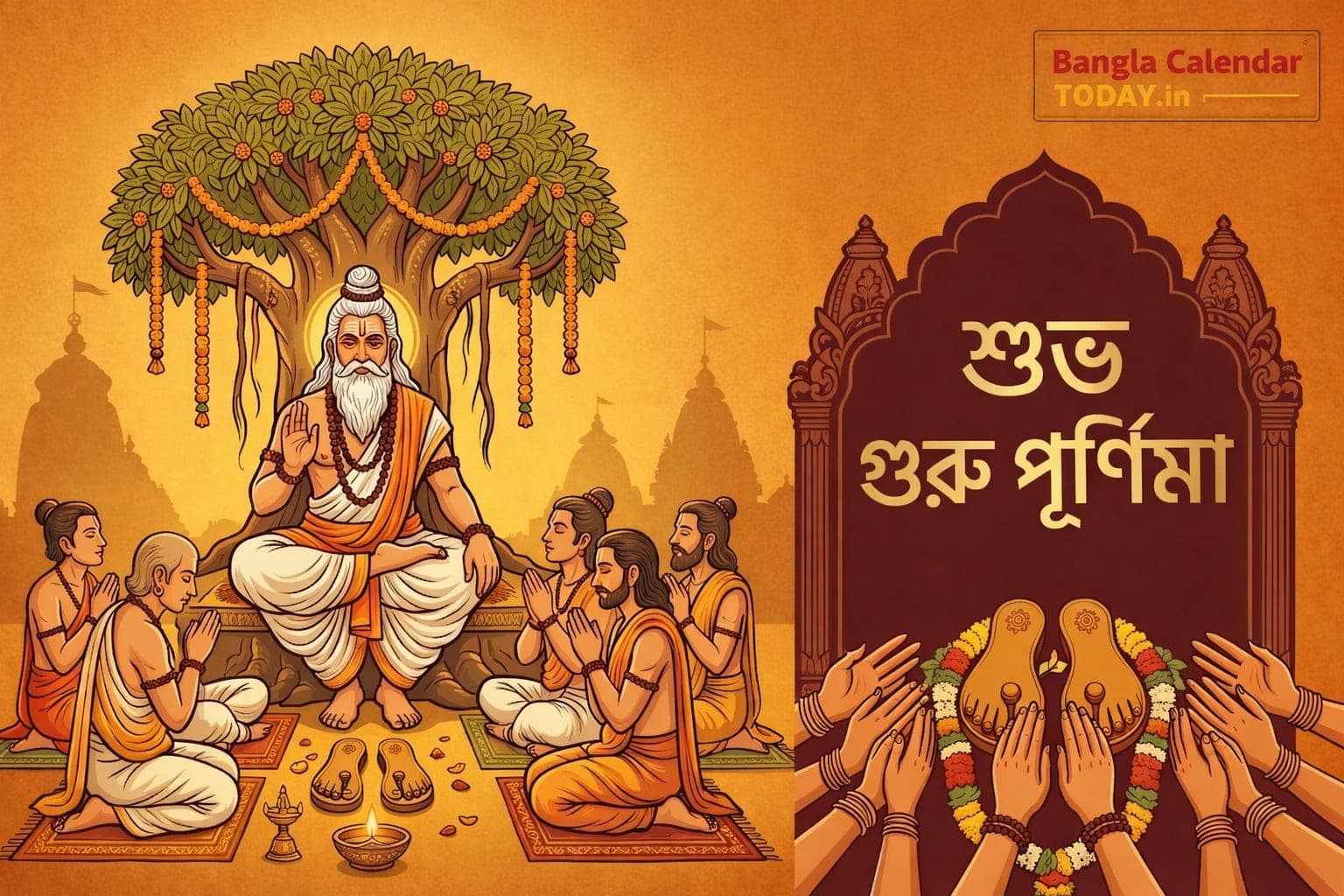
Guru Purnima 2026 | গুরু পূর্ণিমা ২০২৬

Guru Purnima 2026 — a student offering flowers at the feet of their Guru on Vyasa Purnima

Looking for calendar views and tithis?

Read more about the exact tithi timings and planetary alignments in our comprehensive July 2026 Calendar.

View July Calendar →

About Guru Purnima(উৎসব পরিচিতি)

Guru Purnima falls on the full moon day of the month of Ashadha, and in 2026 that means Wednesday, July 29. It is not a loud festival — no crackers, no processions, no melas. What it is, instead, is intensely personal.

The word 'Guru' in Sanskrit breaks down simply: 'Gu' means darkness, 'Ru' means the one who destroys it. So a Guru, at the most fundamental level, is whoever pulled you out of confusion and toward clarity. That could be a spiritual master in an ashram. It could also be your Khayal teacher in Kolkata who spent twenty years correcting your Sa. Or the schoolteacher in a small town who first told you that you were capable of something great.

In Bengal especially, the Guru-Shishya relationship has always been treated with an almost sacred weight. The tradition of sitting at the feet of a Guru — in music, dance, painting, literature — isn't a metaphor here. It was literally how knowledge passed from one generation to the next. And Guru Purnima is the day the student pauses, looks up, and says: I see what you gave me.

History: The day is also called Vyasa Purnima. According to tradition, it marks the birthday of Maharishi Ved Vyasa — the extraordinary sage who compiled the four Vedas, wrote the eighteen Puranas, and then, as if that weren't enough, composed the Mahabharata. He is considered the Adi Guru, the first teacher, the one who essentially organised the entire body of Hindu spiritual knowledge so it could survive and be transmitted.

Beyond the Vedic tradition, Guru Purnima holds equal importance in Buddhism. It is said that on this day, the Buddha gave his very first sermon at Sarnath to his five disciples after attaining enlightenment — setting the wheel of dharma in motion. For Jains, this is the day Mahavira accepted his first disciple, Indrabhuti Gautam, making him a Guru.

In Bengal, the tradition runs through music lineages (gharanas), classical dance schools, and spiritual communities with particular depth. The relationship between a Tagore Songs teacher and her students, between a Dhrupad ustads and their shagirds — these bonds are part of how Bengali cultural identity has always sustained itself. Guru Purnima is when those bonds are formally acknowledged.

Significance: What makes Guru Purnima different from Teachers' Day (celebrated in September to honour Dr. Radhakrishnan's birthday) is the quality of what's being honoured. Teachers' Day is about education. Guru Purnima is about transformation.

The Guru in Indian tradition is not just someone who explains things. The Guru is the one who sees you — your actual potential, behind whatever confusion or laziness or fear is currently in the way — and steadily, sometimes ruthlessly, helps you become it. That's a different kind of relationship. And this full moon day in Ashadha is when students of all kinds reflect on that debt.

In 2026, the Ashadha Purnima Tithi begins on the evening of July 28 and continues through July 29 — making the 29th the primary day of observance across West Bengal and the rest of India.

Rituals & How to Celebrate

Visiting your Guru in person — if they are alive and accessible. Touching their feet, offering flowers or fruit, sitting quietly in their presence for a while. That's the core of the day.
Guru Puja in music schools, dance academies, and spiritual ashrams — students gather to perform before their Guru, not to show off, but as an offering.
Vyasa Puja — in temples and ashrams, a formal worship of the image or symbol of the Adi Guru Vyasa, often accompanied by readings from the Bhagavata Purana.
Guru Dakshina — a humble offering. In the ancient tradition, this was whatever the student could genuinely afford: a fruit, a cloth, money, or simply a heartfelt commitment to continue the practice.
Satsang and spiritual discourses — many monasteries and spiritual centres across Bengal hold all-day programmes of kirtan, meditation, and talks on the Guru-Shishya tradition.
For those whose Guru is no longer alive — sitting in meditation, revisiting old teachings, playing or singing a piece they learned from them. The remembrance itself is the ritual.

Traditional Foods & Bhog

Khichuri Bhog — offered in ashrams and temples as prasad. Simple, fragrant, shared.Seasonal fruits — mangoes especially, since July is peak mango season in Bengal. Many students bring a basket of good mangoes as Dakshina.Payesh (rice pudding) — cooked at home and shared as a mark of the full moon day.Vegetarian thali — most households observe the day without meat or fish.Bengali sweets — Mishti Doi, Sandesh, or Pantua, offered at the Guru's home or at the school.

Festival Calendar

Jul29

Guru Purnima

১৪ শ্রাবণগুরু পূর্ণিমা ২০২৬

Wed

Frequently Asked Questions

Quick Info

FestivalGuru Purnima
Date29 July 2026
DayWednesday
Tithiদ্বাদশী
Bangla Date১৪ শ্রাবণ ১৪৩২
Pakshaশুক্লপক্ষ

Panjika Details

Sunrise5:15 AM
Sunset6:25 PM
Nakshatraআশ্লেষা
Yogaসাধ্য
Karanaনাগ
Guru Purnima 2026: Date (July 29), Vyasa Purnima Significance & Bengali Traditions