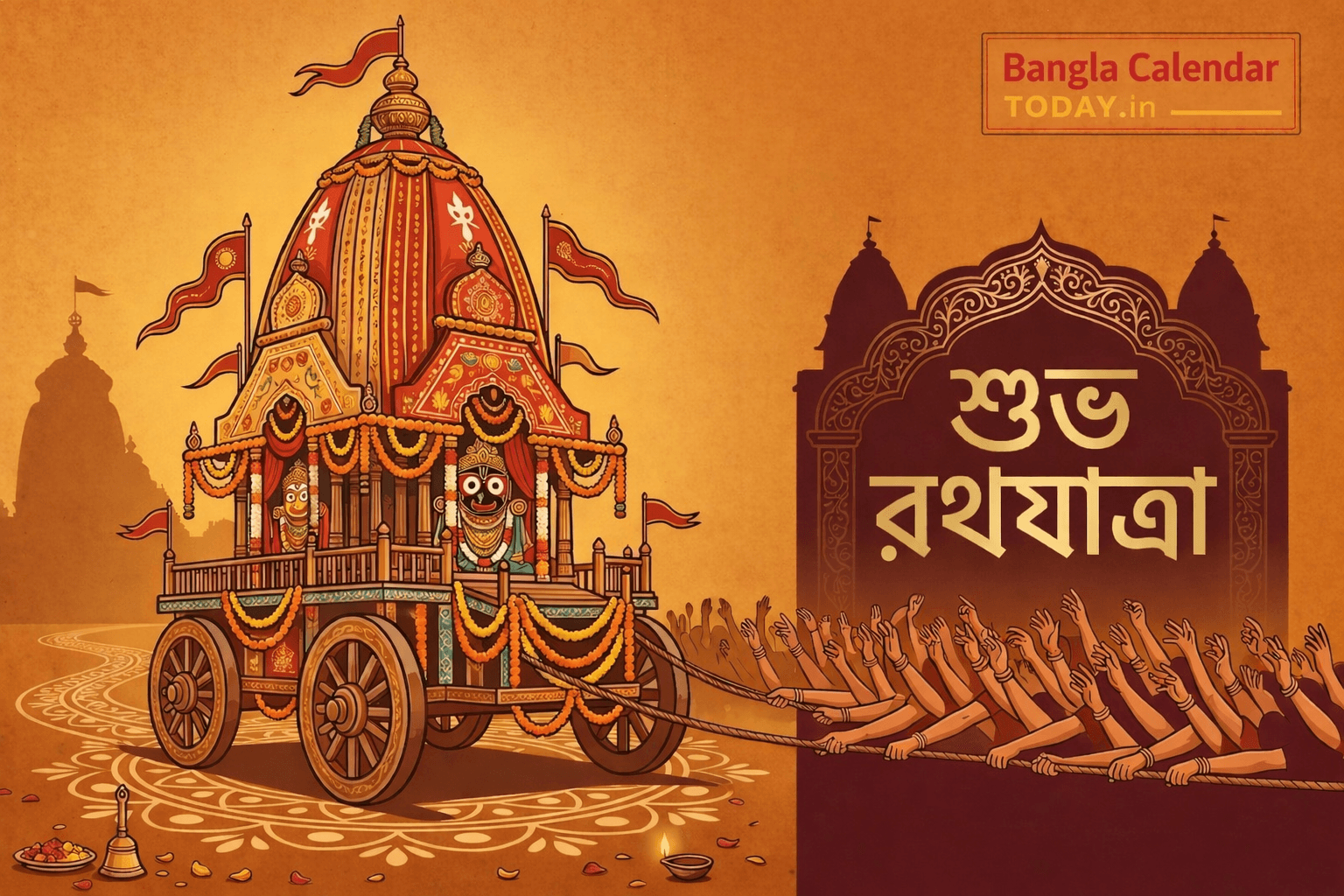
Ratha Jatra 2026 | রথযাত্রা ২০২৬

Ratha Jatra 2026 — Lord Jagannath, Balabhadra, and Subhadra grand chariot festival celebrations in Puri, Odisha, Mahesh, and major cities across India

Looking for calendar views and tithis?

Read more about the exact tithi timings and planetary alignments in our comprehensive July 2026 Calendar.

View July Calendar →

About Ratha Jatra(উৎসব পরিচিতি)

There's something about Ratha Jatra that gets under your skin in the best way possible. Maybe it's the first rumble of the drums you hear from two streets away. Maybe it's that unmistakable smell of incense mixed with monsoon rain and freshly fried Jalebis from the mela stall at the corner. Whatever it is, the moment those giant wooden wheels start turning, something shifts inside you.

In 2026, Ratha Jatra falls on Thursday, July 16. On this day, Lord Jagannath — the Lord of the entire universe — along with his elder brother Balabhadra and sister Subhadra, step out of their temple in Puri and travel to their aunt's home (the Gundicha Temple) in three enormous chariots. For nine days they stay there, and on July 24 they make the return trip in what we Bengalis lovingly call the Ulto Rath.

For Bengalis, Ratha Jatra isn't just an Odia festival we observe from a distance. It's deeply ours too. The ISKCON procession through Kolkata draws lakhs of people. Every neighbourhood has its own small Rath. And for anyone who grew up in Bengal, Rath Yatra is inseparable from the memory of eating Papad Bhaja at a mela with sticky fingers and not caring even a little bit.

History: The Puri Jagannath Temple has been holding this festival for centuries, but what makes it feel personal for Bengalis is Mahesh.

Mahesh, in Serampore, Hooghly district — that's where Bengal's own chariot story begins. The year was 1396. A Bengali sage named Drubananda Brahmachari couldn't make it to Puri to offer bhog to Lord Jagannath. Heartbroken, he had a dream where the Lord told him to go back home, build a temple in Mahesh, and start the festival there. He did exactly that. And it has been running without a break since.

Sri Chaitanya Mahaprabhu himself came to Mahesh on his way to Puri. He was so moved by the devotion of the place that he renamed it 'Naba Nilachal' — New Puri. That name wasn't just a compliment. It was a recognition that this small town on the banks of the Ganges carries the same sacred weight as the original.

Today, the Mahesh chariot is a 50-foot iron giant, weighing 125 tonnes, built in 1885 by the Martin Burn Company. It is the oldest Rath Yatra in Bengal and the second oldest in the world. When it rolls, you feel the earth move — not metaphorically.

Significance: Ratha Jatra is observed on the Dwitiya Tithi (second day) of the bright fortnight in the month of Ashadha. In 2026, this Tithi starts at 11:50 AM on July 15 and ends at 8:52 AM on July 16 — which is why the morning of the 16th is when all the action happens.

But the festival doesn't start on July 16. It actually begins a full 17 days earlier, on June 29, with Snana Yatra — the ceremonial bath of the deities using 108 pitchers of sacred water. After this bath, the Lord is considered to have caught a cold (yes, even the Lord of the Universe is not immune to monsoon fever) and retreats into seclusion for 14 days. This period is called Anasara. Temples are closed. No public darshan.

Then, just before Ratha Jatra, the deities reappear in their glowing, youthful form during Netra Utsav — and that first glimpse after the long wait is something devotees describe as unlike anything else. After nine days at the Gundicha Temple, they return on July 24. On the way back, the chariots pause at the Mausi Maa Temple, where the Lord is fed Poda Pitha — a baked sweet rice cake — by his aunt. Even gods make family visits.

Rituals & How to Celebrate

Snana Yatra (June 29): The deities are bathed ceremonially with 108 pitchers of sacred Suna Kua water — after which they enter a quiet 14-day recovery period.
Anasara (June 30 to July 14): The sanctum is closed. Devotees use this waiting period for fasting, prayers, and quiet reflection.
Netra Utsav: Two days before the Rath, the deities 'reappear' — freshly painted, radiant, youthful. This is the Navayauvan Darshan.
Pahandi Bije: The deities are brought from the temple to their chariots in a slow, swaying ceremonial walk — devotees consider merely watching this to be a blessing.
Chhera Pahanra: The Gajapati King of Puri sweeps the chariot floor with a gold-handled broom. The king of a kingdom bowing before the Lord — this ritual makes the point that no one is above devotion.
Chariot Pulling: Thousands of people pull the three chariots by hand along the Grand Avenue (Bada Danda). Even a single tug on the rope is said to be auspicious.
Bahuda Yatra / Ulto Rath (July 24): The return journey. The chariots pause at the Mausi Maa Temple for Poda Pitha.
Suna Besha: Back home, the deities are dressed in solid gold ornaments — a spectacular ritual that only a handful of festivals in the world can match.

Traditional Foods & Bhog

Papad Bhaja — the unofficial food of Rath Yatra in Bengal. Hot, crunchy, and best eaten standing at a mela stall.Jalebi — fresh, orange, and dripping with syrup. Non-negotiable.Khichuri Bhog — the kind of simple, fragrant yellow lentil rice that tastes like devotion.Poda Pitha — a baked rice and jaggery cake traditionally offered to the Lord during Bahuda Yatra.Malpua — soft, syrup-soaked pancakes. Found at most Rath-er Mela stalls across Bengal.Labra — the mixed vegetable dish that appears as prasad in most homes on this day.

Festival Calendar

Jul16

Ratha Jatra

শ্রাবণরথযাত্রা ২০২৬

Thu

Frequently Asked Questions

Quick Info

FestivalRatha Jatra
Date16 July 2026
DayThursday
Tithiচতুর্দশী
Bangla Date১ শ্রাবণ ১৪৩২
Pakshaকৃষ্ণপক্ষ

Panjika Details

Sunrise5:15 AM
Sunset6:25 PM
Nakshatraধনিষ্ঠা
Yogaশূল
Karanaবণিজ
Ratha Jatra 2026: Date, Puri Rath Yatra Timings & Bengal Mahesh History