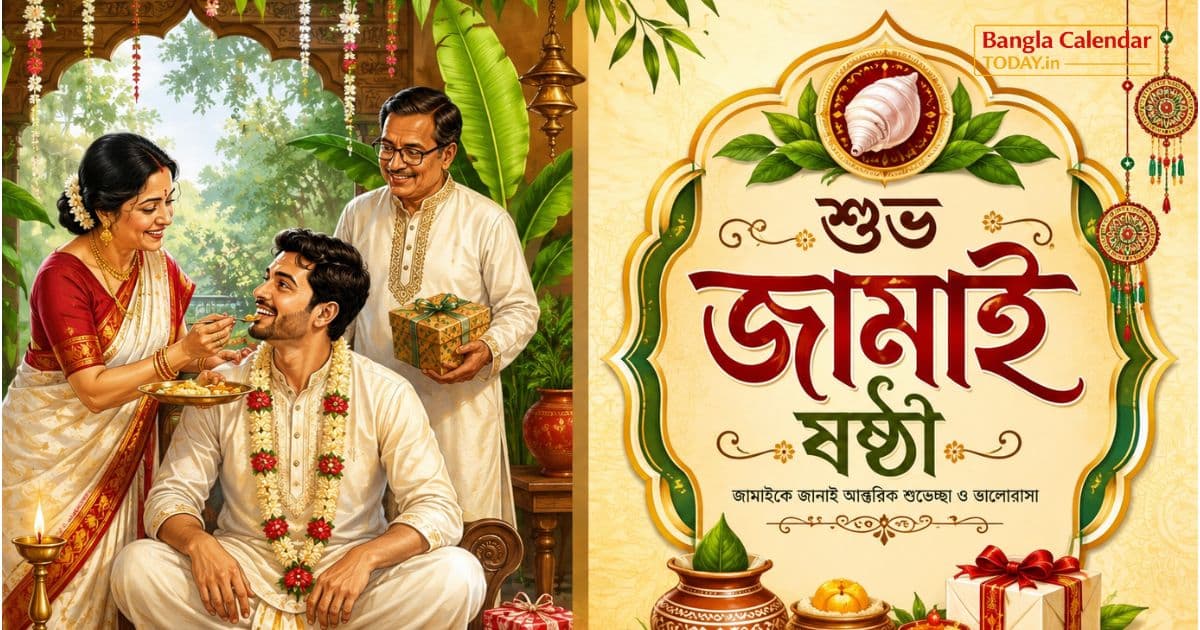
Jamai Shashthi 2026 | জামাই ষষ্ঠী ২০২৬

Jamai Shashthi 2026 — Traditional son-in-law welcoming rituals, talpatar pakha fanning, and grand multi-course feasts celebrated by Bengali families across Delhi, Mumbai, Bangalore, and all over India

Looking for calendar views and tithis?

Read more about the exact tithi timings and planetary alignments in our comprehensive June 2026 Calendar.

View June Calendar →

About Jamai Shashthi(উৎসব পরিচিতি)

Jamai Shashthi 2026, falling on Saturday, June 20, 2026 (Jyeshtha 6, 1433 in the Bengali calendar), is one of the most culturally unique and joyously celebrated festivals in Bengal. It is a day dedicated entirely to pampering, honoring, and showering affection upon the son-in-law (Jamai). Stemming from deep-rooted social traditions, this summer festival is marked by the rich aromas of seasonal fruits like Himsagar mangoes, jackfruits, and litchis, coupled with the cooling breeze of traditional palm-leaf hand fans (talpatar pakha). In every Bengali household, a mother-in-law (Shashuri) leaves no stone unturned to prepare an extravagant, multi-course feast (ভুরিভোজ) for her Jamai, welcoming him as the guest of honor.

From the early hours of the morning, homes are decorated with fresh flowers, mango leaves, and alpana. Devotees perform sacred prayers dedicated to Goddess Shashthi, the divine guardian of children and family lineage, seeking her blessings of longevity, health, and prosperity for the son-in-law and the daughter. When the Jamai arrives, he is welcomed with traditional shell-blowing (Sankhadhwani) and an arati. For the modern Bengali community in West Bengal, Tripura, and Bangladesh, Jamai Shashthi is not just a ritual but a grand annual reunion. It is an occasion that beautifully bridges generations, bringing together maternal and marital families in a warmth-filled celebration of domestic harmony, laughter, and premium gastronomy.

History: The origins of Jamai Shashthi are deeply intertwined with Bengali folklore and ancient agrarian history. Legend has it that in a traditional village, a greedy daughter-in-law secretly ate all the delicacies, particularly the fish and sweets, and blamed it on a black cat. Since the cat is the sacred mount (Vahana) of Goddess Shashthi, the deity of fertility and children, the goddess was angered by the lie and withheld her blessings from the family's lineage, causing their children to fall ill. Realizing her grave mistake, the daughter-in-law performed strict penances and worshipped Goddess Shashthi to seek forgiveness.

Her parents, deeply distressed because they had not heard from their married daughter for a long time, devised a clever plan. They declared a special ceremony to worship Goddess Shashthi and formally invited their son-in-law along with their daughter to their home. When the couple arrived, the parents threw a grand feast in their honor to ensure the son-in-law felt highly respected and happy, which in turn guaranteed the daughter's well-being and freedom to visit her maternal home. Over the centuries, this domestic custom evolved into 'Jamai Shashthi'. It became a standard social practice across Bengal to ensure that married daughters, who traditionally moved far away to their husbands' homes, could return to their maternal homes at least once a year during the peak of summer, when the harvest is abundant and sweet fruits are in season.

Significance: The spiritual and social importance of Jamai Shashthi 2026 lies in its ability to foster familial bonds and preserve ancient household rituals. Worshipping Goddess Shashthi on this day is believed to secure the longevity, robust health, and prosperous future of the son-in-law and the couple's children. In Bengali culture, the Jamai is traditionally viewed with a sense of deep respect and occasional distance; this festival beautifully breaks that ice, replacing formality with playful affection and pure maternal love. It is a day when the mother-in-law directly expresses her gratitude and blessings, ensuring that the daughter remains cherished and happy in her new household.

On a cultural level, Jamai Shashthi celebrates the culinary heritage of Bengal. Coming at the height of the Jyeshtha month, it represents a beautiful celebration of nature's summer bounty. In Bengal, sweet mangoes like Himsagar, Lyangra, and Amrapali, along with giant jackfruits and sweet litchis, are offered to Goddess Shashthi before being served to the family. It is also an economic catalyst for local markets, where fishmongers stockpile giant Hilsa (Ilish) and Golda Chingri (Prawns), and sweetshops craft specialized giant sandesh and mishti, keeping traditional sweet-making artistry alive.

Rituals & How to Celebrate

The mother-in-law performs a welcoming Arati for the Jamai using a brass platter (barandala) containing a brass lamp, fresh durba grass, and unhusked paddy (dhan) to bless him.
Tying the sacred yellow 'Shashthi Suto' (a cotton thread dyed with turmeric) around the son-in-law's right wrist while chanting prayers for his long life and health.
Gently fanning the Jamai with a wet, traditional palm-leaf hand fan (talpatar pakha) to cool him down and symbolically ward off evil spirits.
Dabbing the Jamai's forehead with curd (doi) and unhusked rice grains to bring good fortune and auspiciousness.
Exchanging premium gifts, where the son-in-law brings sweets and seasonal fruits, and the in-laws present him and their daughter with exquisite new clothes (panjabi, dhoti, or designer shirts).
Serving the legendary 'Jamai Shashthi Thali', a massive multi-course lunch featuring traditional Bengali delicacies lovingly prepared by the mother-in-law.

Traditional Foods & Bhog

Basanti Pulao (sweet yellow rice fragrant with ghee and saffron)Luchi (deep-fried puffy bread) served with Cholar DalGiant Ilish Macher Sorse Jhal (Hilsa fish in a rich mustard gravy)Golda Chingri Malaikari (Jumbo prawns in a luscious coconut milk cream)Kosha Mangsho (slow-cooked, rich and spicy mutton curry)Sweet Mangoes (Himsagar, Langra) and fresh, sweet litchisTraditional Misti Doi, Rajbhog, and customized 'Jamai Sandesh' sweets

Festival Calendar

Jun20

Jamai Shashthi

আষাঢ়জামাই ষষ্ঠী ২০২৬

Sat

Frequently Asked Questions

Quick Info

FestivalJamai Shashthi
Date20 June 2026
DaySaturday
Tithiতৃতীয়া
Bangla Date৬ আষাঢ় ১৪৩২
Pakshaশুক্লপক্ষ

Panjika Details

Sunrise5:10 AM
Sunset6:30 PM
Nakshatraশতভিষা
Yogaগণ্ড
Karanaচতুষ্পদ
Jamai Shashthi 2026: Date, Bengali Son-in-Law Rituals, History & Feast